Understanding your options after previous nose surgery
When I meet someone who is unhappy with a previous rhinoplasty, I recognize that there may be two kinds of scars: physical scars and deformity, and emotional scars from disappointment. The thought of another operation and another financial commitment can bring both hope and anxiety. You may be wondering whether a bridge that looks too scooped, a tip that points too far upward, or breathing that has become more difficult can be improved. I want our conversation to address both your concerns about your nose and your concerns about going through surgery again.
I use the term revision rhinoplasty to describe surgery that addresses a concern after a previous rhinoplasty. It may improve appearance, nasal function, or both. The operation can range from a limited correction to extensive reconstruction. What I can realistically accomplish depends on what remains beneath the skin. 1
My approach begins with a candid conversation about what is achievable. In a nose that has already been operated on, particularly more than once, the goal is often better, not perfect. That is not a reason to give up on improvement. It is a reason to plan carefully and understand the limits before making another surgical decision.
Why revision rhinoplasty is more difficult
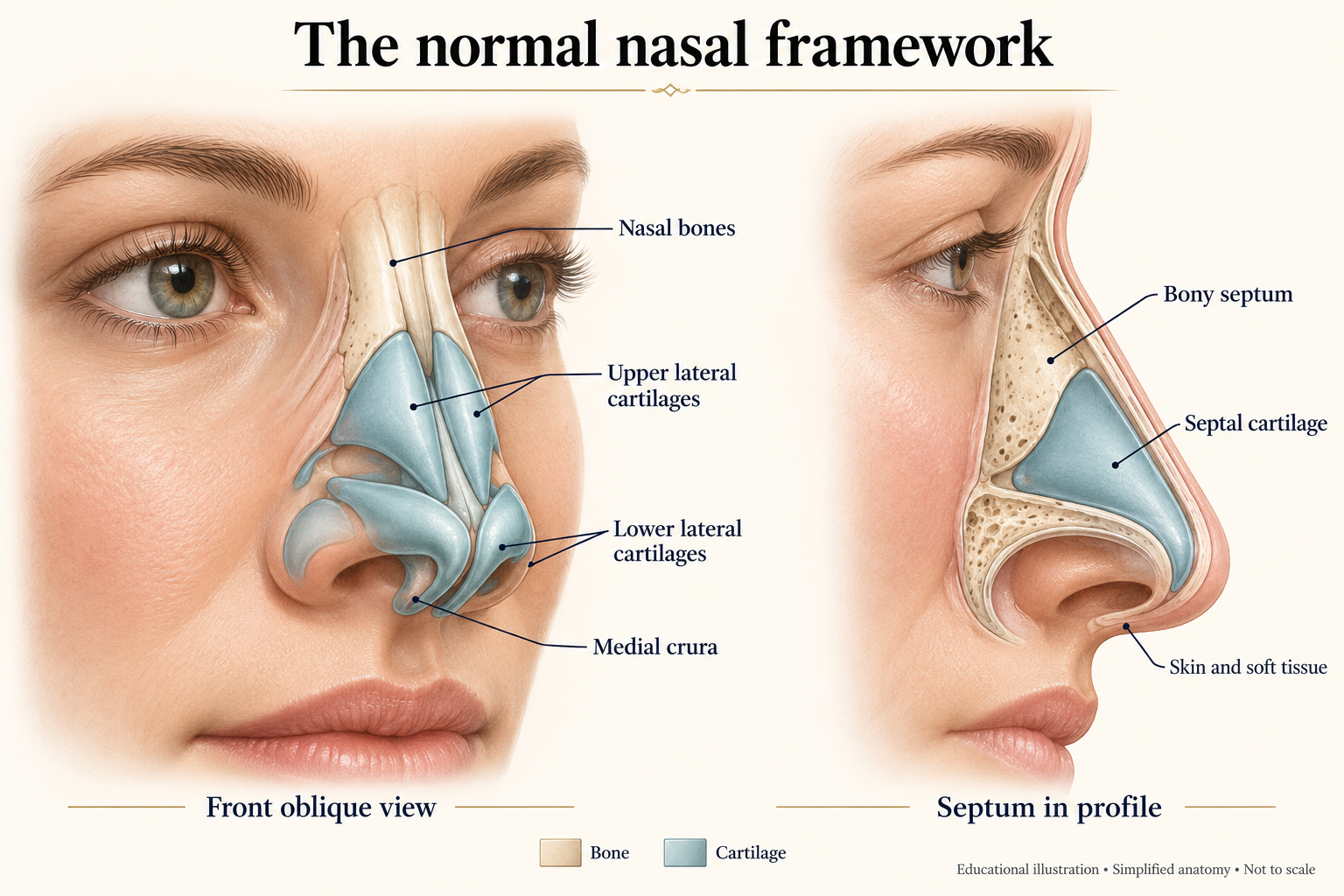
When I operate on a previously treated nose, I work with anatomy that has already been changed. Scar tissue can obscure the normal structures, cartilage may have been removed or repositioned, and the remaining framework may no longer provide adequate support. Prior surgery can also limit the cartilage available for reconstruction. 2
I sometimes find that an apparently small contour problem requires substantial reconstruction. The full extent of the previous surgery may become clear only during the revision. 2
Repeated surgery adds another layer of difficulty. I want patients to understand why another operation is being recommended, which changes are realistic, and which imperfections may need to be accepted. A persuasive promise is much less useful than a clear explanation of the problem and the proposed solution.
Even after 25 years of performing revision procedures, I cannot fully know what lies beneath the skin until I examine the tissues during surgery. I request prior operative reports whenever possible, but those records do not always capture every detail of the previous surgery or the changes that developed during healing. I make a surgical plan before the operation and discuss possible adjustments with you. During the initial exploration, I become a detective of sorts: I assess the remaining cartilage, scar tissue, and support, then refine the reconstruction to match what I find. This is where I draw on my experience.
Common concerns I evaluate after a previous rhinoplasty
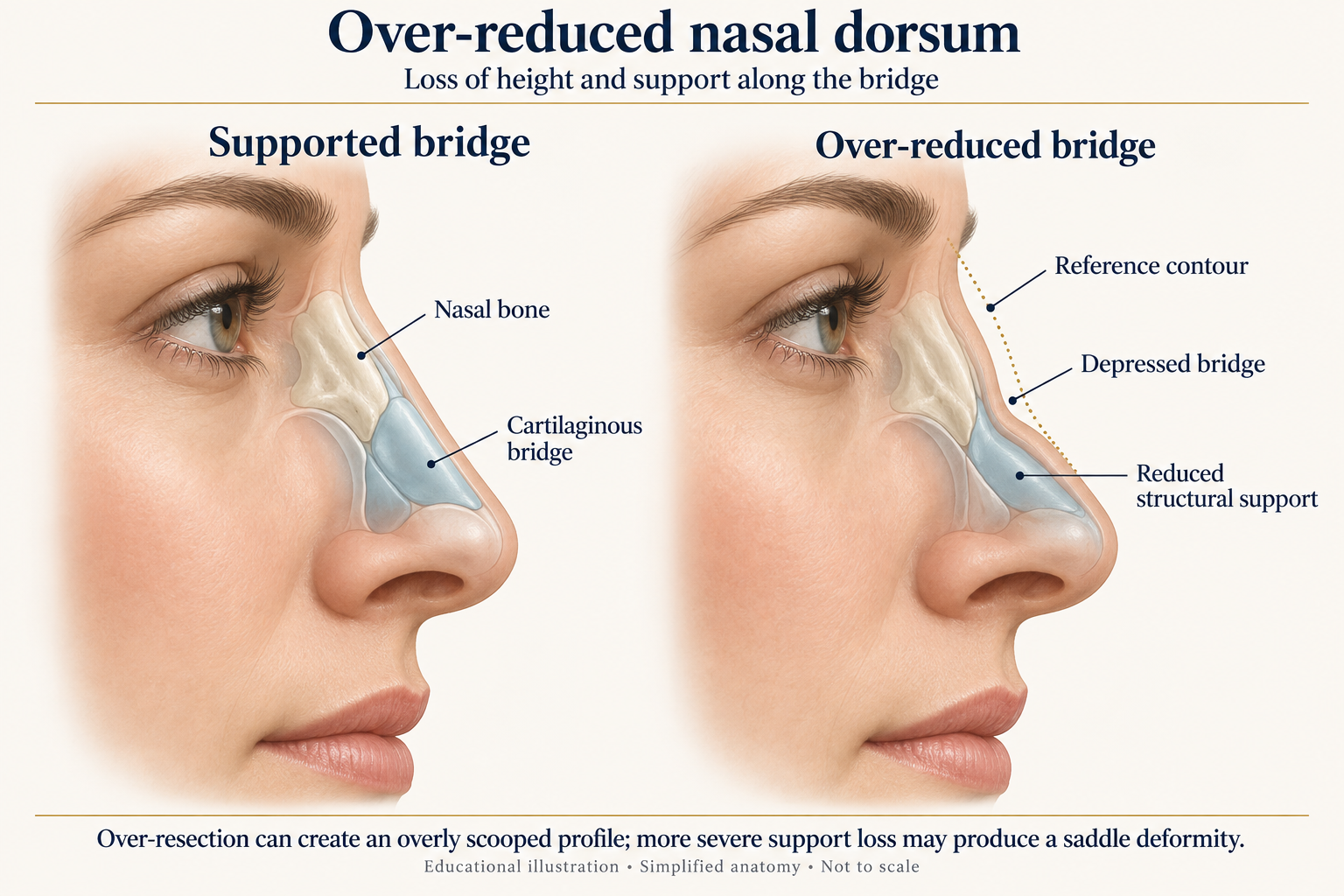
A bridge that looks too scooped
The nasal bridge is also called the dorsum. When I assess a bridge that looks too scooped, I look for loss of supporting bone or cartilage. Excessive removal can create a deep dip or, in more severe cases, a saddle appearance. I may need to restore height and support. The amount and location of the deficiency guide that decision. 3
I do not consider a gently curved profile an automatic complication. I look at whether the shape fits your face, preserves adequate support, and is acceptable to you. I do not believe there is one ideal profile for every person.
A tip that looks too short or too upturned
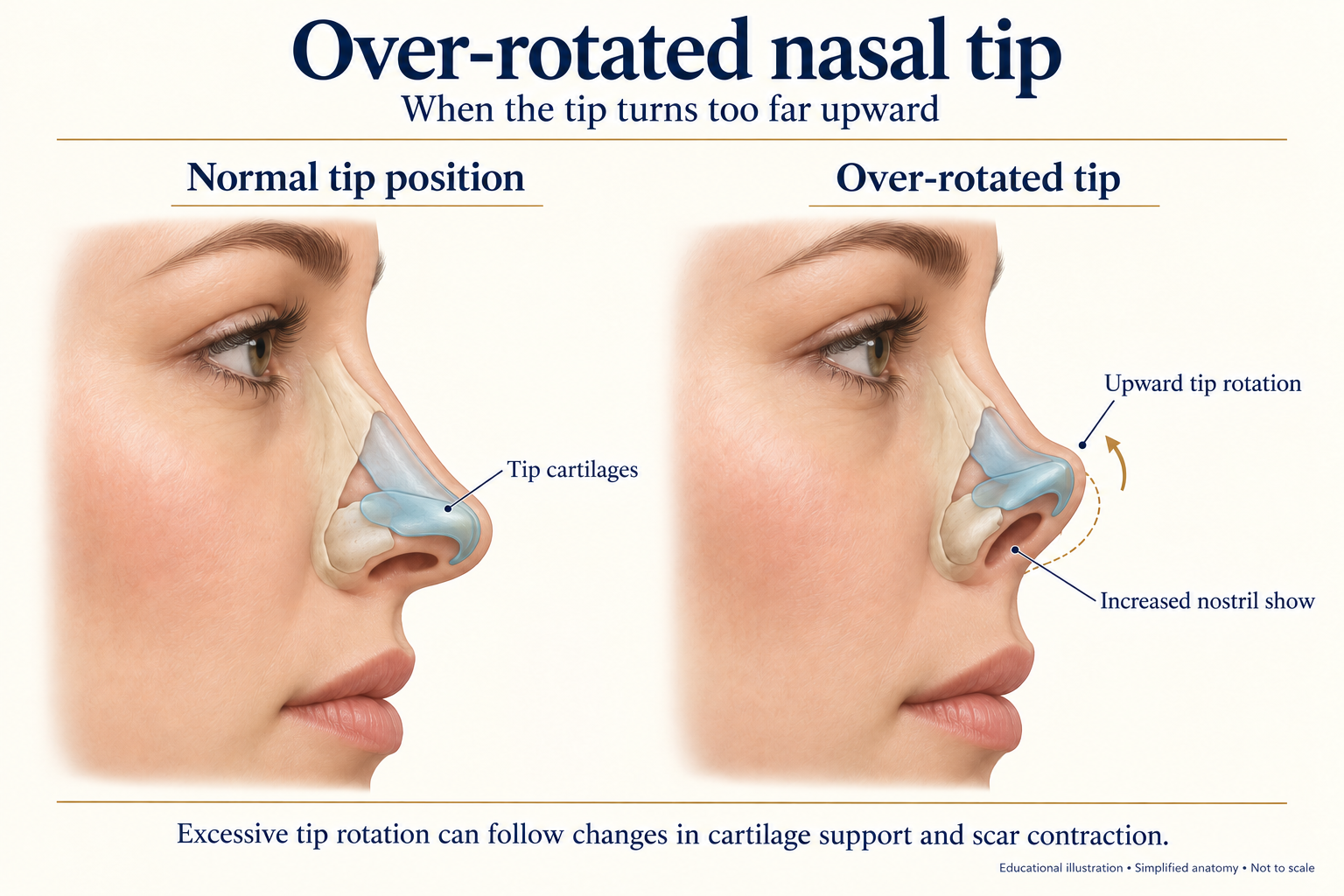
For a shortened nose or an excessively rotated tip, I assess whether support and length can be restored. Either problem may expose more of the nostrils than you wanted. Scar contraction and the available skin can limit how much change I can achieve. Correction is rarely as simple as moving the tip downward. 4
Fullness above the tip known as a pollybeak
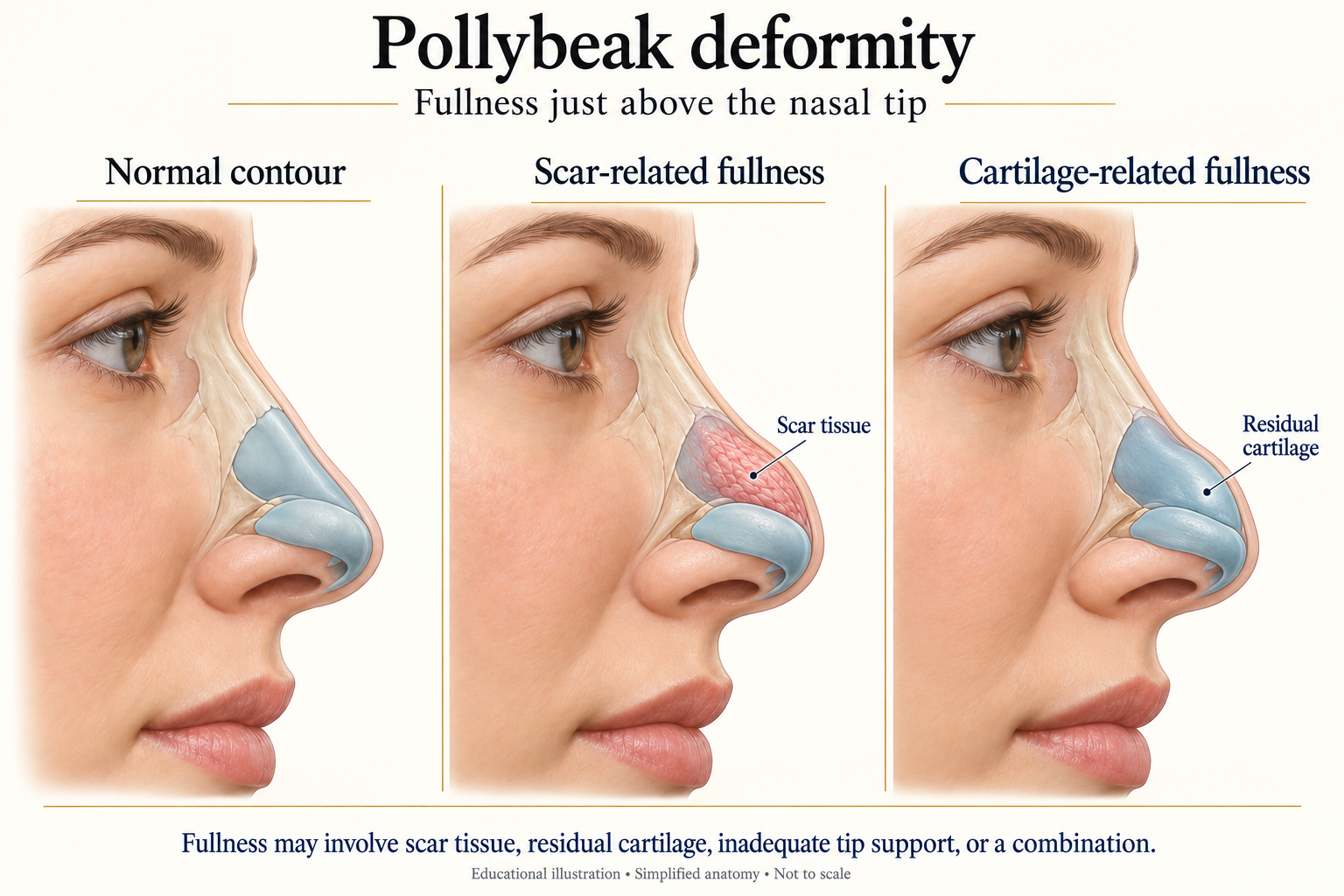
A pollybeak is a rounded prominence just above the nasal tip that interrupts the profile. Before I recommend treatment, I need to distinguish among several possible causes: scar tissue, residual cartilage, loss of tip support, or an imbalance between the bridge and tip. I do not assume that this appearance means too much cartilage was removed. 5
I base treatment on the cause. For selected scar-related fullness, I may recommend treatment without another operation, with appropriate follow-up. A structural problem may require surgery. Simply reducing the fullness without understanding why it is there can leave the underlying problem unaddressed. 5
A pinched appearance or difficulty breathing
The nasal valves are narrow regions of the nasal airway. Weakness or collapse in these areas can contribute to obstruction, sometimes alongside a pinched appearance. I examine the airway when you describe breathing difficulty because a deviated septum, enlarged turbinates, or other problems may also be involved. When I identify valve dysfunction, I consider its repair as a distinct part of the treatment plan. 6
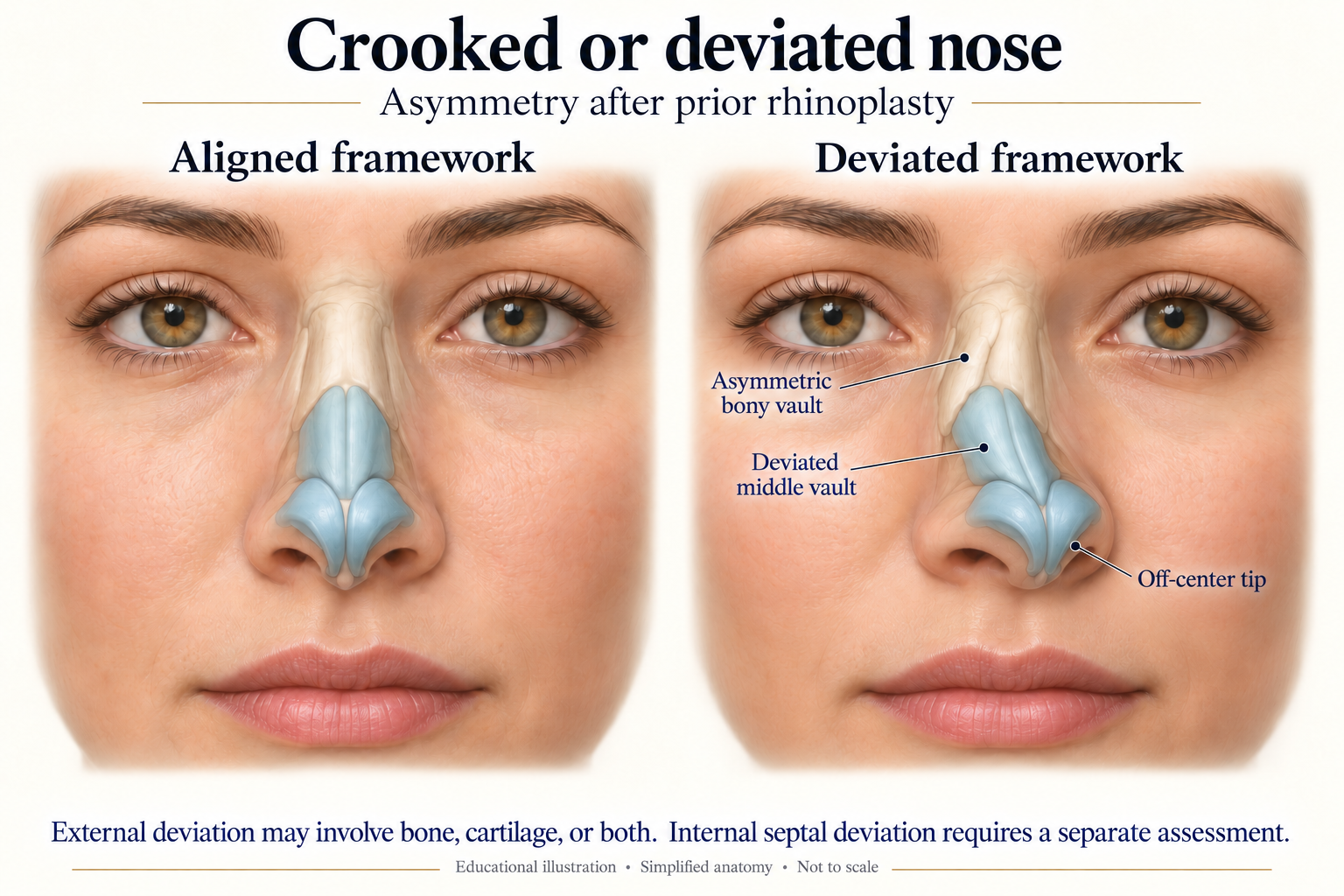
Crookedness and contour irregularities
I also evaluate uneven bridges, visible graft edges, and persistent contour depressions. Some concerns are limited; others reflect a broader imbalance in the nasal framework. I want you to understand the cause of an irregularity and the tradeoff involved in correcting it. 3
What I assess during your consultation
I begin by asking which concerns matter most to you. Is the main issue appearance, breathing, or both? Has it changed as swelling has settled? Which feature is most bothersome, and what would count as meaningful improvement?
I review your previous operations, examine your skin and supporting structures, and evaluate your airway. Earlier photographs and operative reports can be helpful, particularly when cartilage was removed or grafts were placed. I also consider whether your expectations and the proposed operation are well matched. 4
I encourage you to bring available records and a written list of questions. Photographs can help you show me what concerns you, but I cannot establish a complete surgical plan from a photograph alone. Before we decide on another operation, I want you to be able to explain in your own words what I intend to improve and what may remain unchanged.
Why I may recommend cartilage grafts
When support has been lost, I may need to add cartilage. A graft is a piece of tissue used to reinforce or reshape the framework. I may use cartilage from the septum, the partition inside the nose, or from the ear or rib if the septum cannot provide enough suitable material. Each source has advantages and limitations. 2
I use grafts to restore support, replace missing volume, or help address a weakened airway. I also discuss donor-site discomfort and scarring, as well as the possibility of graft warping or visibility. My choice follows the reconstruction needed. 2
Before surgery, I explain whether I anticipate grafting, where the cartilage would come from, and how the plan might change during the operation. I also explain why I recommend an open or closed approach for your anatomy. I want the reasoning behind each choice to be clear to you.
How I decide when revision is appropriate
For most elective revisions, I recommend allowing the first operation time to heal. That commonly means waiting at least 12 months, and sometimes 12 to 18 months or longer depending on the situation. Swelling and tissue changes can make an early result difficult to judge. 7
When I recommend waiting, I am referring to another elective operation. You can still seek an assessment while you heal. I may recommend observation after that consultation. If you develop new or worsening breathing problems or other postoperative concerns, I encourage you to contact your treating surgeon promptly.
What I explain about recovery
I explain recovery in stages. Feeling ready to return to ordinary activities is different from seeing the final shape of your nose. Initial swelling improves over the first weeks, while smaller contour changes continue for months. Even after primary rhinoplasty, refinement can take up to a year, and swelling may fluctuate during that time. 8
In my experience, selected complex revisions, especially noses that have undergone several operations, can continue settling for two to three years. That is not the expected timeline for every patient. It is a possibility I want patients with difficult reconstructions to understand before surgery.
At follow-up, I assess whether changes reflect expected healing or a concern that needs attention. I provide instructions about activity, splint care, medications, and reassessment. I encourage you to avoid judging your outcome from a single early photograph or comparing your healing directly with someone else’s. 8
I recognize how difficult patience can be when you have already been disappointed. Before surgery, I explain how I will assess progress, when we will compare photographs, and whom you can contact between visits.
How I weigh improvement and the risks of another operation
I believe revision rhinoplasty can offer meaningful improvement, but I am careful about how I discuss the evidence. In one study comparing 54 revision patients with 54 primary rhinoplasty patients, both groups reported improved satisfaction after surgery, although improvement was greater in the primary group. I view that finding as evidence of possible benefit, not a prediction of your individual result. 9
I discuss risks that include infection, anesthesia complications, scarring, changes in sensation, breathing difficulty, septal perforation, persistent asymmetry, and dissatisfaction with appearance. I also explain that another revision may still be needed. I assess the risks most relevant to you in light of your anatomy, health, previous surgery, and planned reconstruction. 10
Sometimes I recommend waiting or avoiding another operation. If the likely improvement is modest and the potential downside is substantial, accepting a remaining imperfection may be the better decision. I believe that discussion belongs in our consultation just as much as the discussion of what surgery can accomplish.
What I want you to ask about experience and cost
I encourage you to ask about my training, credentials, and experience with revision problems similar to yours. When we review photographs, I want you to understand the starting problem and when the postoperative images were taken. A dramatic photograph without context tells only part of the story.
I welcome questions such as these:
- What is causing the problem in my nose, and what would you do to address it?
- Which improvements are realistic, and what are the main limitations?
- Will breathing be assessed and addressed as part of the plan?
- Might I need cartilage grafts, and what additional risks would that involve?
- Where will surgery take place, who will provide anesthesia, and how will follow-up work?
- What happens if the result still falls short of the agreed goals?
I encourage you to discuss price openly and to consider it alongside the proposed operation, relevant experience, facility, anesthesia, and follow-up. Ask me for an itemized estimate and clarification of what is included. I do not believe that a lower price makes a poorly suited plan a bargain or that a higher price guarantees a better result.
Questions I am often asked
Can a bad nose job be fixed?
I can often improve unwanted changes, but I cannot promise complete correction. Before surgery, I work with you to set a realistic goal: better, not perfect. I assess what caused the problem, how much usable support remains, and whether the expected benefit justifies another operation. 1
Can revision restore my original nose?
I frame the goal as specific, achievable improvements. I cannot promise to recreate every detail of the nose you had before surgery. Earlier photographs help you show me what you miss and which features you hope to regain.
Can a third or fourth rhinoplasty be considered?
I may consider another revision, but I make that decision individually. The number of operations alone does not answer the question. I assess the condition of your tissues, remaining support, breathing, and achievable goals. In multiply operated noses, I place particular emphasis on the limits of further reconstruction and the length of recovery.
How much does revision rhinoplasty cost?
I need to develop an individual surgical plan before discussing a meaningful estimate. I encourage you to ask what the quoted fee includes, such as my surgical fee, the facility, anesthesia, graft-related needs, and follow-up. I want you to understand the financial commitment before you make a decision.
Taking the next step
If you are considering revision rhinoplasty, I want our consultation to give you a clearer understanding of your nose and your options. I will examine you carefully and explain the proposed treatment, its limits, and the reasons I may recommend proceeding, waiting, or leaving things alone.
To discuss revision rhinoplasty with me at BellaNova Cosmetic Surgery in West Palm Beach, call (561) 834-6682 or visit bellanovasurgery.com.
Explore my rhinoplasty before and after gallery and learn more about revision cosmetic surgery.
References
- Chaffoo R. Understanding revision rhinoplasty and why patients seek out this procedure. American Society of Plastic Surgeons. 2019.
- Bussi M, Palonta F, Toma S. Grafting in revision rhinoplasty. Acta Otorhinolaryngologica Italica. 2013;33(3):183–189.
- Dorsal Failures: From Saddle Deformity to Pollybeak. Facial Plastic Surgery. 2018;34(3):261–269. doi:10.1055/s-0038-1653990.
- Jiang A, Chamata ES, Bressler FJ. Revision Rhinoplasty: With Introduction of a Novel Preoperative Assessment Classification System. Seminars in Plastic Surgery. 2021;35(2):78–87.
- Oğuz O, Bozdemir K, Bayar Muluk N, Cingi C. Pollybeak deformity in rhinoplasty: prevention and treatment. European Review for Medical and Pharmacological Sciences. 2024;28(7):2696–2700.
- American Academy of Otolaryngology–Head and Neck Surgery. Position Statement: Nasal Valve Repair. Revised July 2026.
- The Rhinoplasty Society. Revision Rhinoplasty: Addressing Complex Cases with Expertise.
- American Society of Plastic Surgeons. Rhinoplasty Recovery.
- Abbas OL. Revision rhinoplasty: measurement of patient-reported outcomes and analysis of predictive factors. SpringerPlus. 2016;5:1472. doi:10.1186/s40064-016-3166-5.
- American Society of Plastic Surgeons. Rhinoplasty Risks and Safety.
I am Dr. Albert Carlotti, a cosmetic surgeon at BellaNova Cosmetic Surgery in West Palm Beach. I have more than 25 years of experience in cosmetic surgery. This article provides general education; I base individual recommendations on an in-person examination.